
Can sustainable urban design and landscape architecture help combat global warming?

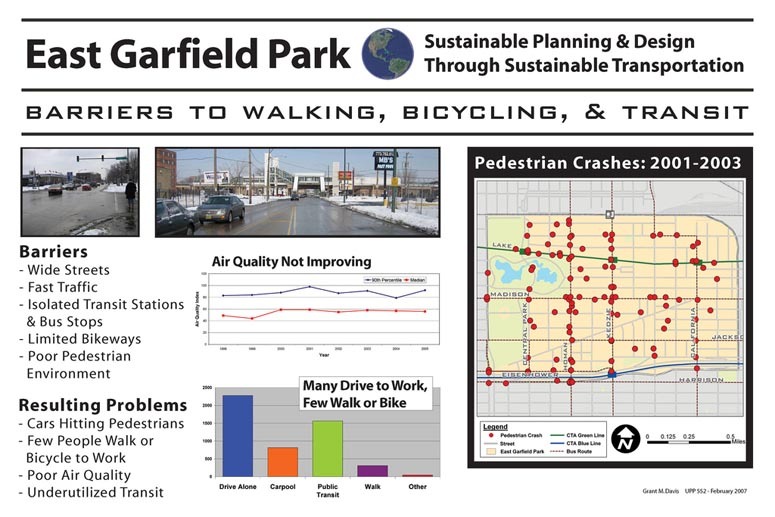
Designing urban landscapes for motor vehicles discourages human-powered transport

Designing urban landscapes for motor vehicles discourages human-powered transport


Watching Al Gore’s Inconvenient Truth at one sitting led me to the following conclusions:

  1. The film is excellent and has much to teach college lecturers, both about the analysis of complex issues and about the the use of words & images in presenting an argument.
  2. Gore’s argument is weakened by his homepage link to a Buy Now button on climatecrisis.net – regardless of how he shares the profits. It makes him seem like a greedy evangelist on TV.
  3. Gore’s list (below) of Thing’s You Can Do Now, is ultra-trivial and may have set back the cause by encouraging politicians to believe that little change is necessary. The film mentions population growth but it is not on the list, doubtless for ‘political’ reasons.
  4. The best commentary on the issues comes from Justice Burton. He said the film is ‘broadly accurate’ but listed nine inaccuracies
  5. A landscape approach to urban design can do more to combat climate change than Al Gore can imagine. We can and should:
  • use all roofspace:  for vegetation, gardens, power generation or the daylighting of interior space
  • plan cities for extensive use of human-powered and solar-powered transport (above image courtesy TouringCyclist) – but see my recent post on White Commuting
  • compost as much as possible within the boundaries of each and every property
  • infiltrate as much water as possible within the boundaries of each and every property
  • make all buildings energy efficient, by orientation, vegetation, insulation, durability, daylighting, avoidance of lifts and escalators etc
  • design new homes so they can become home offices, when eCommuting becomes the norm, with a smooth transition from indoor to outdoor spaces with differential climatic and temperature characteristics

For landscape architects and urban designers thinking about new jobs and professional opportunities in sustainable urban design, the above are  very convenient truths.



Al Gore does not say enough about urban design

Al Gore does not say enough about urban design


Another ‘inconvenient truth’ ignored by Gore, is that the environmental impact of bottled water has been calculated, by SGWA, to be 1000 times greater than that of tap water. So ban it, as a small town in Australia has done: Bundanoon, in New South Wales. Perhaps the American language needs a new word: an ‘ingored truth’
Garden archaeology has much to teach conventional archaeological exploitation


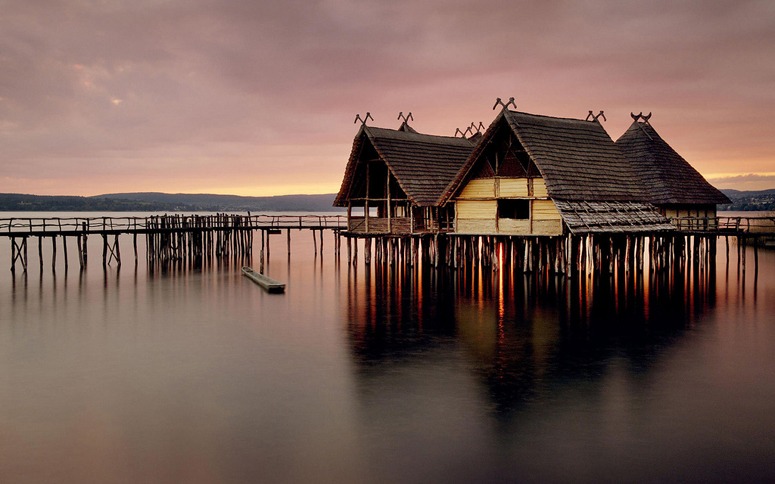
A Bronze Age Reconstruction which does much good and no harm


Pompeii would be in much better condition today if had never been excavated – and the same is true of a great many archaeological sites. Too many archaeologists are paid to publish papers or to support the tourist industry. They talk about conservation, endlessly, but they do far more good than harm. Since garden archaeologists have so few ancient gardens to damage, they should set an example to the archaeological profession by making reconstructions of ancient gardens. Images, text and digital reconstructions are all useful but nothing is as good as a 1:1 reconstruction near, but never on, the archaeological remains.  The lake dwellings in the above photographs are reconstructions of dwellings from the Bronze and Stone Ages. (at the Pfahlbau Museum Unteruhldingen, Germany).  Image courtesy Derek


Christianity, music, sacred trees, garden design and the architecture of a new landscape

Dorothy Frances Gurney wrote that “One is nearer God’s heart in a garden/Than anywhere else on earth.” Her father and husband were Anglican priests – so some might read this as her criticism of male egotism! Or one might think that the Miserere sung in Europe’s most perfect building (I would give this award to King’s College Chapel) takes you closer to ‘God’s heart’. The Vatican kept the music private for centuries. Mozart went there, memorized the score, went home and wrote it down.

Christianiaty has a chequered relationship with art and gardens. Gardens are celebrated in the Song of Solomon and the Garden of Eden story (see blog post) but the Christians felled sacred trees throughout Europe and have never given gardens the support they have had in Buddhism and Islam. Last time I saw the garden of Lambeth Palace (London home of the head of the Church of England) it was an utter disgrace – and most Church of England cloister garths are badly or inappropriately managed. Anglican Christianity is losing support for a host of reasons but Christian music is entirely holding its own – always making the case for a simple, idealistic and joyful approach to the world. The drive for perfect simplicity + imaginative creativity, as seen in Kings College Chapel, may be connected to Bill Gates’ obsevation that he liked Cambridge because it had won more Nobel prizes than the rest of Europe put together.

My own view, as a ninth generation skeptic, is that while there is something utterly wonderful about Christianity, it is in urgent need of renewal ( perhaps a ‘New New’ Testment). So I wonder what garden designers can contribute to the architecture of a new landscape.

We have had apologies for the Crusades and the Inquisition. Please can we now have a full and frank apology for the felling of Sacred Trees – and then a quest to produce a contextual design as perfect as the singing of the Miserere in King’s College Chapel. This is my Christmas and New Year wish for 2010, made on the day after the pagan New Year (21 December) and therefore a day of hope for the return of warmth, sunshine and flowers. London is having a cold, wet and slushy end to a year of economic turmoil.

PS A different musical response to the nature of the world, kindly drawn to my attention by a Chinese landscape architect, can he heard in the beautiful Yuzhou Changwan (‘Singing at night on fishing boat’):

PPS If the two pieces of music are run similtaneously the result is curious East-West mashup.

White commuting is another reason for wanting cycletubes in urban areas

It snowed yesterday. About half London took the day off and my cycle to work took twice as long. When I set off  home the back roads were covered with icy ruts. After about 20 minutes of precarious travel I came level with a bunch of 25 teenagers wearing hoods. They moved into the road and surrounded me as I drew level. Then they pelted me with icy snowballs. I wobbled, stayed upright and had to stop to dig the snow out of my ears. My wife asked why my voice sounded hoarse when I got home.  ‘Too much bad language at full volume’ I explained. The kids, no doubt,  were just having fun – relieving the ennui of urban life – but they made me wish God would release a sheaf of thunderbolts. Sadly, the morning news had nothing about lightning-strikes on groups of hoodies in South London – so I have another reason for wanting cycle tubes for green communters. Meanwhile, I will learn the rest of the poem:

Cannon to right of them,
Cannon to left of them,
Cannon in front of them
Volley’d and thunder’d;
Storm’d at with shot and shell,
Boldly they rode and well,
Into the jaws of Death,
Into the mouth of Hell
Rides the poor cyclist.

Effective policies re global warming, climate change, urban design, sustainability and landscape architecture

Scotland's Old Red Sandstone was laid down in hot, dry, arid conditions - about 400 million years ago. Homo sapiens evolved about 4 million years ago and is not responsible for this climate change

Scotland's Old Red Sandstone was laid down in hot, dry, arid conditions - about 400 million years ago. Homo sapiens evolved about 4 million years ago and is not responsible for the climate change from hot arid desert to cold wet coast.

The expert science behind the theory of global warming is unimpeachable and unchallengable: thermometers show temperatures are rising and tape measures show glaciers are retreating. But several important questions have uncertain answers:

  1. What percentage of global warming is caused by burning fossil fuels and felling rain forests?
  2. What percentage difference would result from the measures advocated by reasonable scientists?

The answers to these questions would be useful. My guesses are (1) humans have caused only a small percentage of the global warming in the last 20,000 years (2) the measures currently under discussion, though I am in full support of them, would have next-to-no-effect on climate change. If we are serious about doing whatever little we can do to lessen climate change then we should consider the following moderate measures:-

  • Stop world leaders from wasting their time and our money on conferences in Kyoto, Copenhagen etc, or, if this proves difficult, make them spend their time using Copenhagen’s wonderful bicycle network instead of its limousines, its cavernous conference halls and its spikey cocktail bars
  • Ban the consumption of meat
  • Make it illegal to drive children to school – at any time in any country
  • Stop wasting hydrocarobons on road transport and air travel (making every place a holiday destination would help)
  • Stop war and stop making munitions and use the money to build giant solar energy farms in dry deserts
  • Extend Chinese population control policies to Africa, along with its mineral resource policies
  • Use  suburban gardens for home-grown food and vegetables, especially in America and Australia
  • Facilitate voluntary euthanasia
  • Legalize heroin, cannabis, cocaine etc – to get more tax revenue to spend on protecting rain forests – and stop the waste of resources on ineffective drug enforcement policies in rich and in poor countries
  • Vegetate most walls and most roofs in most cities of the future
  • Put 300 mm of insulation in most roofs, floors and walls
  • Train more landscape architects and urban designers
  • Replace the World Bank and the UNDP with Jamie Lerner
  • ‘In the prison of his days teach the free man how to praise’ (W B Yates)

Image courtesy Earthwatcher

Kerb – is landscape architecture dead? – a magazine review

RMIT University in Australia publish the annual publication Kerb and Vol 17 asks the question ‘Is landscape architecture dead?’. It is a good question and a handsome volume with interesting illustrations. But most of the articles in Kerb led me to think that ‘if this is the future of landscape architecture, then it deserves to die’. The images do not have either captions or any discernable relationship with the text. Most of the 26 articles are inconsequential: significant questions are asked; random assertions are made; obscure paragraphs abound eg1 ‘Contemporary landscape architecture has not produced an aesthetic paradigm that describes the vicissitudes surrounding the idea of nature today’ (p 10),  eg2 ‘landscape is not an object. yet this image of landscape is projected upon the world with each project you undertake’ (p.73)  eg3 ‘interpret ‘scape as meaning ‘pretty dress up’. Dig up a Chinese creek bed, polish the booty, and dress up my ‘scape outside the screen door’ (p.92). But I must be wrong: many young Australian landscape architects come to work in London and they have earned a good reputation for Australia’s landscape schools.