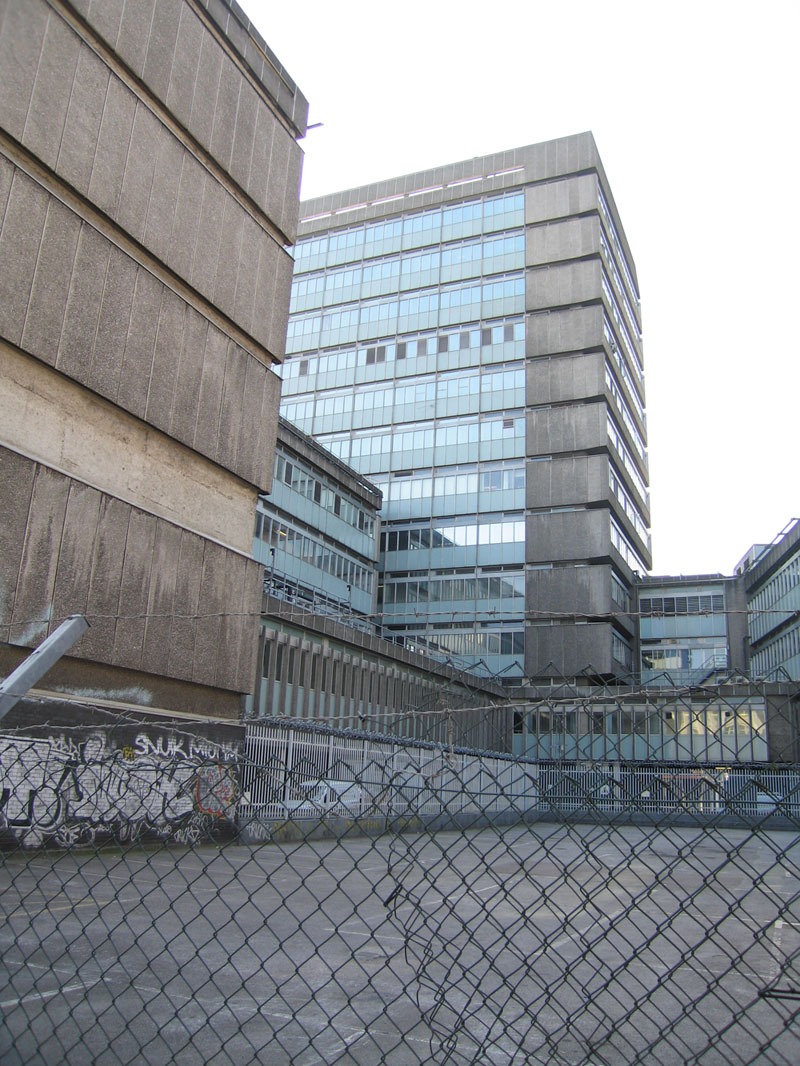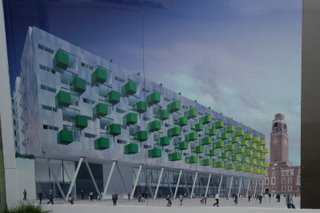
This photo (taken near Waterloo East Station in South London) helps make the point that the ‘urban design theory’ underpinning the misguided design of Barking Town Square dates from the 1960s. It was wrong then and it is wrong now. Muf Architecture’s office is in East London but they could well have been inspired by Waterloo. Note the chain link fencing. Why not plant it with convolvulus? – the Rasta temple in Camberwell could let us regard this as a context-sentsitive approach! Or, better, plant it with runner beans – nice red flowers and then some good organic food to eat.
Urban, urbane or uber-urban?
Rosanna Vitiello & Marcus Willcocks, researchers with an interest on the relationship between the urban realm and our sensory coding, as part of their joint project ‘The Impact of the Unknown – Unravelling the Urban Lexicon’ speak of the Barking and Dagenham Council’s project as “an impressive regeneration programme” in their blog of October 2007.
Is anyone aware whether they have conducted follow-up research with ‘Participants’?
Saving the past can help save the present
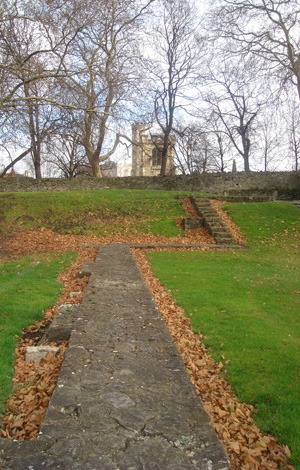
The remnants of Barking Abbey in their landscape setting are beautiful and memorialise an incredible period of Essex history. A continuing interest in local history is not just important for those citizens who derive their sense of identity from the area, for history buffs or lovers of heritage. History gives many insights into global climate cycles which are important to us all now and can help planners construct a longitudinal view of land and climate relationships;
“High tides again in 1409, sweeping through or over the river walls, flooded 600 acres of meadow in Dagenham marsh, and destroyed 120 acres of wheat in another marsh. “
Source: BBC website.
Gardenvisit.com 10th Birthday
Gardenvisit.com was launched in October 1998. So now we are ten! Unlike many ‘Dotcom Frenzy’ websites, the aim was not gold. Feeling a little smug about having the text of my 1986 book on English Garden Design since 1650 as a computer file (rolled on from BBC format to MSDOS), I wanted to do something with it.
Like Ted Nelson, I was attracted to the idea of a hypertext publication in which readers could chart their own routes. This was done by putting in hyperlinks from the 1986 text to pages about specific gardens and biographies of designers, painters, patrons etc. Another aim, still only partially achieved, was to bring together the histories and theories of garden design and landscape architecture.
The first book I wrote was about both these subjects. But when the publisher dropped out I could not find a replacement. Other potential publishers told me that it should be two books and this is what it eventually became: one on English garden design since 1650 and the other on Landscape Planning and Environmental Impact Design. Both are now available on the Gardenvisit.com website, together with about 25 other online eBooks. I continue to edit content for Gardenvisit.com, no longer as owner-manager, and other topics have sprung from the original content: Garden Tours and Garden Design/Products. They are linked by a concern for Context-sensitive Design, which has become a main theme of this Blog. ‘What know they of England who only England know?’, asked Kipling (see Sukh Mahal). Travel induces a love of places, a context-sensitive design approach – and a need to visit ever more gardens!
Having been too serious for a birthday, here is my Grandad’s favourite garden joke:
Vicar, looking over a hedge: “Ah. What a wonderful job you and God have made of the front garden”
Parishioner: “Ah. You should’ve just seen it when God had it to ‘imself”

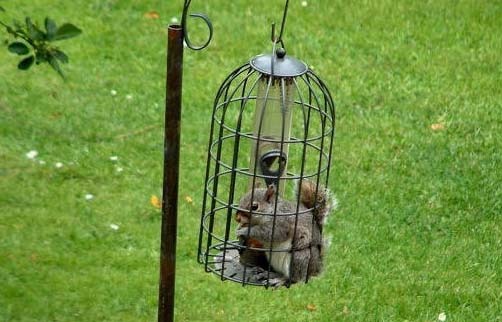
Squirrel-proof bird feeder cage
Public Art in Barking Town Square
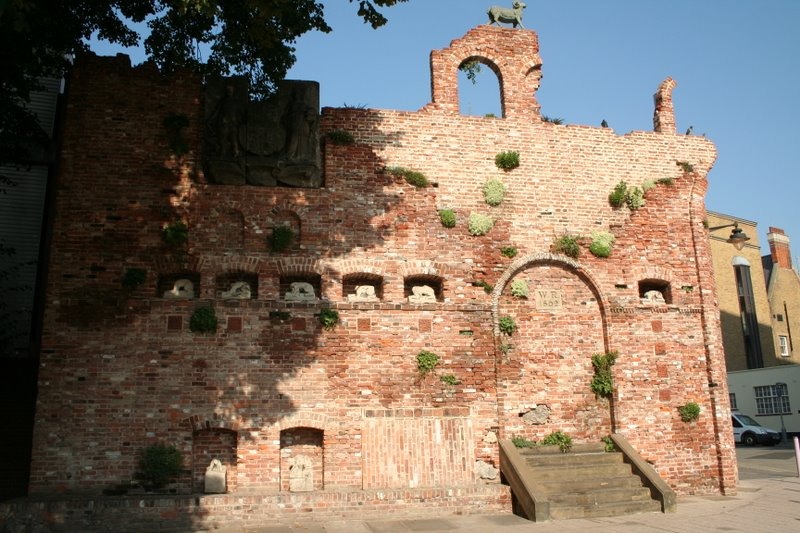
Nothwithstanding our criticism of the urban design of Barking Town Square, Muf deserve an award for an excellent piece of public art on the northeast side of the Square. Muf state that ‘The folly screens the flank wall of Iceland supermarket and makes the fourth elevation to the town square. The folly is comprised of architectural salvage and recovers the texture of lost historic fabric of the town centre; it stands as a mementomori to this current cycle of regeneration.’
Unlike the usual ‘Turd in the Plaza’ approach to public art, this wall:
(1) serves an urban design objective by enclosing the space
(2) picks up on the historic context of Barking
(3) pleases the eye without being attention-seeking
I wish we could have more context-sensitive public art.