
The UK Landscape Institute should consider itself in the position of Robert the Bruce in a cave on Rathlin Island in the winter of 1305 watching a spider trying to make connections from one area of the cave’s roof to another. The LI has achieved good things but has suffered defeats. It should seize the breathing space offered by the recession to think again and plan for the future. ‘If at first you don’t succeed, try try again.’ Are the problems interconnected? Does the Constitution need to be revised?
The LI has lost too much money. It is out of touch with its membership. Its public profile is too low. Its recruitment is far too low. Major opportunities in garden design and landscape planning have been missed. It has too little influence on government policy. There is no PPG Note on landscape matters. UK landscape architects have not achieved the international renown enjoyed by other categories of British designer (eg architects). The LI Journal is a monthly disappointment. The organization is timid and tepid: not hot and yet uncool.
A symptom of the malaise is the complete redesign of the logo, journal and website every few years. Landscape design should be a classic brand – with new leadership and more responsive organization. The forthcoming Council elections are a time for change.
moon garden – detail

tired moons ask higher tides
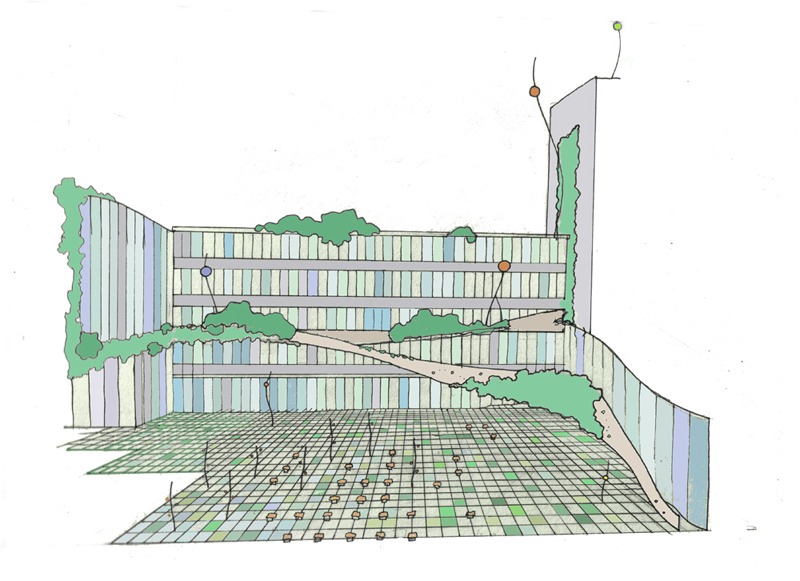 i dont know how we all still feel about moon gardens but here is my latest drawing of the Waterloo site. i think it includes a lot of the ideas we were discussing, but admittedly, leaves some out. in the end, i decided to do what felt right for the space itself. you all might not agree of course.
what it does have is a green ramp leading up to the terraces and roof gardens and some green walls too. at ground level i’ve left it open plan, with the use/function adaptable/open to interpretation. here i’ve been influenced by West8s designs (theres a short piece on them here)
i’m suggesting metal grills for the ground surface as these will reflect available light upwards and lighten the space, perhaps with room for plants to grow inbetween them in an ecological fashion? this could be interesting as different/more plant species would grow in different parts of the ‘garden’ according to the available light and microclimate. parts (or perhaps all) of the metal surface could be also galvanised to show the reflection of the moon at night, tracing its path across the sky.
the other elements are minimal. plenty of seating, which i think is key to the success of any urban open space, and some vertical elements which could include lighting and add a feeling of transition
i still think the site could be improved a lot with the demolion and repositioning of key buildings ( and god its such miserable architecture, who would miss it?). but perhaps these steps would bring back life to a dead zone?
World Garden Finder Facts
In March 2009 the Gardenvisit.com World Garden Finder:
- was ten years old
- contained 2,486 gardens in 61 countries
- had aerial photographs and maps showing the location of every garden
- included 3,500 images
- included a variety of User Generated Comment: images, reviews, ratings and Head Gardener’s Comment
But we want to make it better! Please help us – with reviews, ratings, photographs and descriptions.
The original idea for the garden finder was to provide links to gardens from my online book English garden design: history, philosophy and styles since 1650. [This book also appeared in print, in 1986 and is due to be revised and re-published]. Since 1998 we have published over 25 online books and there is an interesting job to be done in linking them to and from the garden finder descriptions.
The landscape architecture of bicycling in China
 The BBC broadcast a programme on the Fall and Rise of the Bicycle in China http://www.bbc.co.uk/radio4/fallandriseofthebicycle/ which was actually about the Rise and Fall of the Bicycle in China. The main point was that the world’s greatest cycling country aims to become the world’s greatest motoring country. In Beijing the cycle lanes are being narrowed and cars are being allowed to obstruct them. I don’t know if the presenter has experience of cycling in Beijing but I can tell him about another problem: many of the cycle lanes are full of near-silent electric motor bikes. To people like me, who are in the habit of using their ears to discover when a motorbike is about to overtake, this can be very dangerous. I would not want any westerners to be in the position of appearing to say ‘you can’t live as we live’. But I am happy to pronounce that ‘most western countries made a terrible mistake when they switched from bikes to cars (eg from 1920-1960) so please think a thousand times before you make the same mistake. Beijing still has some of the best cycle paths in any capital city (photo courtesy Rich & Cheryl)
A Chinese contributor to the programme explained that riding a bicycle is a working class and driving a car shows that you are an important person. That is why the Chinese landscape architecture profession needs to become involved. Landscape architects can design such safe and beautiful cycle lanes that using them becomes a mark of what used to be the distinghishing characteristic of China’s scholar-officials: GOOD TASTE. Come my Chinese friends and colleagues: show the world what you can do and we should do. Cycle planning should be incorporated with greenway planning and design, in China and everywhere.
Sustainable urban design and landscape architecture – definitions

The Bruntland Commission may have set back sustainable urban design by half a century with an idiotic definition: “Sustainable development is development that meets the needs of the present without compromising the ability of future generations to meet their own needs” It gives anyone who wants it an excuse for doing nothing and claiming they are acting sustainability. What are my ‘needs’: one bicycle or two cars? And what are ‘needs’ of future generations: no bicycles and three cars?
The reason for Bruntland’s blunder is that sustainability is a relative concept, like ‘near’ and ‘far’, incapable of absolute definition. Is the moon near or far from the earth? It is very near for space travelers but very far for cyclists. We should boast an inability to design ‘sustainable cities’ but assert a competence in making cities ‘more sustainable’. As urban designers and landscape architects we do this by planning for fewer inputs and fewer outputs than the International Modern Cities which too many architects and engineers have designed, are designing and will design. Here are some examples:
1. Cities will require less input of water because we are expert in sustainable urban drainage systems – and they will have less output of waste water because we know how to detain and infiltrate water within urban areas.
2. Cities will require less import of construction materials from distant lands because we believe in respecting the Genius Loci and using the local materials which he provides for our use.
3. City building will involve less transport of excavated subsoil to dumps because we will use it design new landforms.
4. Less energy will be required for heating and cooling because we will orientate buildings correctly and design with microclimate.
5. Planting schemes will require less irrigation, less maintenance and less input of chemicals because we will make more use of native plant materials and will make lawns only when they have a social use.
6. People will walk more and cycle more because we will design beautiful and convenient paths – and we will do this before any roads or buildings are planned.
7. When people get more exercise they will have better health, so that the resource inputs for healthcare will also be reduced and we will have less medical waste to dispose of.
8. Buildings will be better insulated, because almost all of them will have vegetated roofs, and will therefore require less heating in winter and less cooling in summer.
9. Cities will be more compact because there will be less roadscape, fewer parking lots and less need for greenspace at street level – because we are going to make such wonderful skyparks and skygardens.
The inputs and outputs exemplified above are all measureable, just as the distance from the earth to the moon is measurable.
See also: Eco-city plans and sustainable design