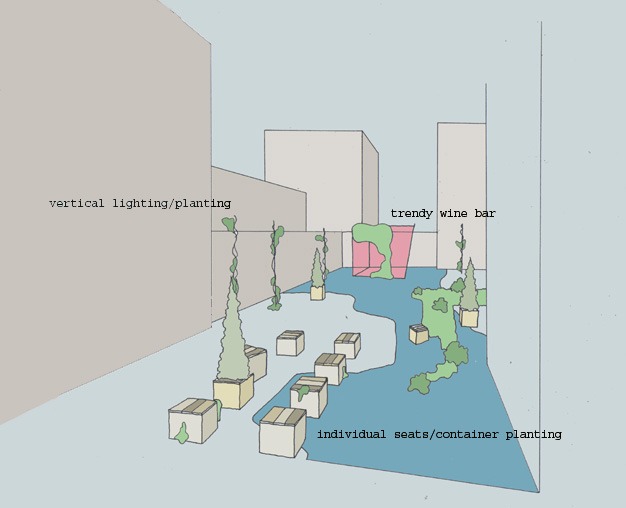
should probably add some notes but its been a mad week and i’m tired. one thing springs to mind. following Christines notes about water fall, it could be important to work a drainage scheme into the design, in which case we’d need to find out what gradients (if any) are present. i suspect site conditions are going to place restrctions on our planting scheme, esp if we want to stick to the white theme, but thats something i’d like to work out once i’ve got the layout nailed. (besides, i suspect out of the three of us Tom is the most proficient plantsman!)
London has just had its heaviest fall of snow for 20 years, making me wonder about global warming and, as a natural contrarian, whether I should be preparing a Winter Edition of the Principles of Garden Design eBook. Amongst other things it would explain how to make ice fountains and how to include rich colours which harmonize with whites and greys. When frost damage becomes a serious problem we will also need to think about making more use of fiberglass. The first few items in our Online Garden Products Shop include some well-made fiberglass planters.
Fiberglass was invented in 1938 and is much used for small boats, cars bodies, bows and arrows, etc. The components are glass fiber and resin. Compared to terracotta, the advantages of fiberglass are (1) high strength (2) moisture retention (2) 100% frost-resistance. Compared to lead, fiberglass is (1) lighter (2) safer.
Fiberglass takes a range of finishes and when detailed as well as these planters can be difficult to distinguish from terracotta and lead. We are also pleased to offer modern designs which take advantage of the inherent qualities of, in garden history terms, an excellent new material. Since the planters are lightweight as well as strong they are very well suited to mail order. We would welcome suggestions for other items to include!
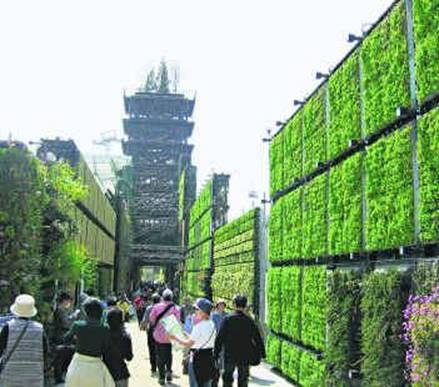
Perhaps our expectations of urban ‘greenspace’ are about to change? This photograph was taken at the AICHI Bampaku expo held in Japan’s Nagoya City in the Aichi Prefecture and published in the Hindu Business Line. The purpose of the Expo was to “generate awareness on issues of pollution, global warming and energy use.”
It raises an interesting question. How far do we want go down the technology route and how far do we want to go in being smarter about how we do things? Perhaps there is a middle way between the two alternatives? How should designers respond to the twentyfirst century challenges of carbon trading and carbon sequestration?
Having criticized Martha Schwartz and long considered Will Alsop the ‘Clown Prince of Architecture’ I was curious to hear them discuss Alsop’s philosophical notion that ‘No landscape architect should ever get hold of these [landscape] commissions because they have completely institutionalized the idea of public space’. As you can see, Alsop’s main complaints against the landscape profession are (1) there are too many about (2) they do not know their trees (3) they are doing too much urban design and master planning (which Alsop would rather do himself?).
Schwartz does a passable job of defending her turf but eventually blurts out the truth ‘You and I are very much alike in how we work’. It would also be interesting to hear Hitler and Stalin debating the philosophical notion that ‘Dictators should never be allowed to run countries’. They might even have agreed to design a Satellite Town – in Poland.
I was sorry to hear Schwartz slagging off garden design. It is a fine art of the highest order and it has laid the basis for the world’s most admired urban designs: Isfahan, Rome, Paris, Georgian London, Beijing and Washington DC. I would also like to refer them both to my proposed definition of landscape architecture.
Can anyone dispute that buildings must be designed in relation to landform, water, planting, and paving? Or that outdoor space should be beautiful, ecological and and socially useful? Are architects or landscape architects able to achieve this? Some are; some are not. Martha Schwartz seems better at aesthetic composition than at dealing with social and ecological issues. Alsop is a bozo: all sop with a dash of pop.
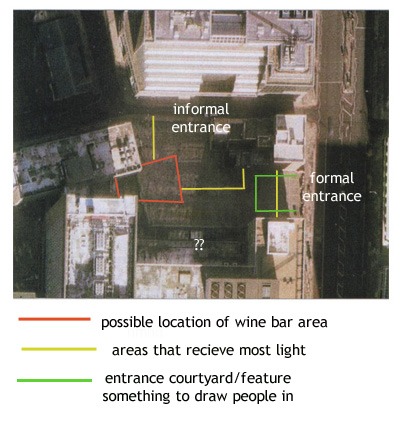
i’ve marked down a likely location for the wine bar area, and a couple of other things beside. the surrounding buildings cast a lot of shade. of course we’ve know way of knowing what time of day/year the image was taken, but can count on the bottom (south) end of the site at least getting less light.
cant make out whats in the alcove created by the buildings at the bottom of the site, it could be a lower rooftop or something at ground level. it looks structural
the right hand side of the site (which i’ve marked down as the formal entrance) could presently be used for parking. an annoyance depending on whether or not we decide to acknowledge it.
also note how the building at the top of the site reflects a lot of light back into the site, creating patterns upon the ground. useful?
Noticing that the Landscape Institute (LI) has produced a draft policy statement on Green Infrastructure which does not contain the word Greenway, I did Google searches on the two terms. The results were:
This inclines me to the view that, at present, the Greenway Concept has more public visibility. There are three problems with the Green Infrastructure Concept: (1) the literature is thin (2) it is unclear whether “green” means “vegetated” or whether it is used as in “green politics” (3) the term “infrastructure” is much better understood by the built environment professions than by the general public. London has many greenways. Some are excellent and others in urgent need of better landscape planning and design.